Showing posts with label Volnovakha. Show all posts

Wednesday, January 21, 2015

Aerial photo from OSCE UAV of Volnovakha shows their own NNE direction was wrong

OSCE published a report about the Volnovakha attack that for the first time(?) includes a photo:


The photo is made by one of their UAVs and shows the checkpoint and part of the impact area:


The nice thing about this is that the impact craters tell us something about the direction where the rockets came from:


We have to be careful to calculate an EXACT angle based on this photo, because the photo itself was taken at an angle and that means the impact-angles get distorted (a bit).
Nevertheless what we can CLEARLY see, is that the direction of impact is at a (slight) angle (red line) with the road (yellow line).

When we copy these lines on a map, it looks like this:


As can be seen, the direction of impact is NOT NNE as was stated by OSCE in an earlier report.
The direction IS consistent with mine and other peoples earlier assessments:


That NNE direction has been used by Russian trolls to argue that that assessment was not correct. And even Russia's envoy to the OSCE used that report to state it was not correct:


To put it mildly, this shows how the 'handwork' of OSCE-members delivering only written reports is NOT RELIABLE enough. The reason is that nobody can check how they came to their conclusions and whether they were right or not.

My suggestion to OSCE is to let their people make photos and videos and release those to the public with their reports.


I will NOT discuss here whether their 'NNE-report' was a deliberate falsification or just a unfortunate human misinterpretation.
But OSCE DOES need to understand that their credibility is not very high at the moment with the public and we have many questions about their neutrality in Ukraine.


Also see: What's the problem with OSCE?
Also see: why did OSCE invite a Russian General to Volnovakha crime scene?


Dokuchajevsk GRAD video was filmed at SAME TIME as Volnovakha attack

My further anonymous user Gnomon suggested a BRILLIANT idea.
As everybody knows, the position of the sun indicates the time of the day. So if we can determine where the sun is, we can check if the Volnovakha GRAD volley was at the same time as the attack!

He writes:
"I want to propose the method of detecting the time of filming for this video.
It is possible to do it by analysing the position of the sun. The image is overexposed, but it is still possible to do this by using the lens flare (it appears on many frames in this video). 
Now THAT is a brilliant idea!

Here is a frame from the video at 1:54 (which is 1 minute before the volley starts, but without cuts in the video), that clearly shows flare (purple streak):


Gnomon explains:


It is well known that the source of light (in our case – the sun), the center of the image and the flare are always placed in the one line. So we need to find a frame that matches the following criteria:
  1. The camera must be placed strictly horizontally.
  2. Flare must be strictly on a vertical line that divides the frame on two equal parts. 
If these conditions are met, than a line drawn from the observer to the middle of the frame placed on the map will show us the direction on the Sun.
In this screenshot the horizon is as good as horizontal and the purple line following the direction of the flare almost goes through the middle, so maybe we will be 5 minutes off, but that will be in the margin of error anyways.
Now note that the line goes through the third structure from the right on top of the roof .

When we draw this line on the map it looks like this:


The cameraman is on the balcony (red circle). From there we draw a line through the third structure on the roof (purple line).

For now just remember this: the position of the sun and therefore the direction of this line tells us what time it is.
I will skip the part what time exactly, since with UTC, GMT and daylight savings it might get very confusing. But we don't need that anyways.

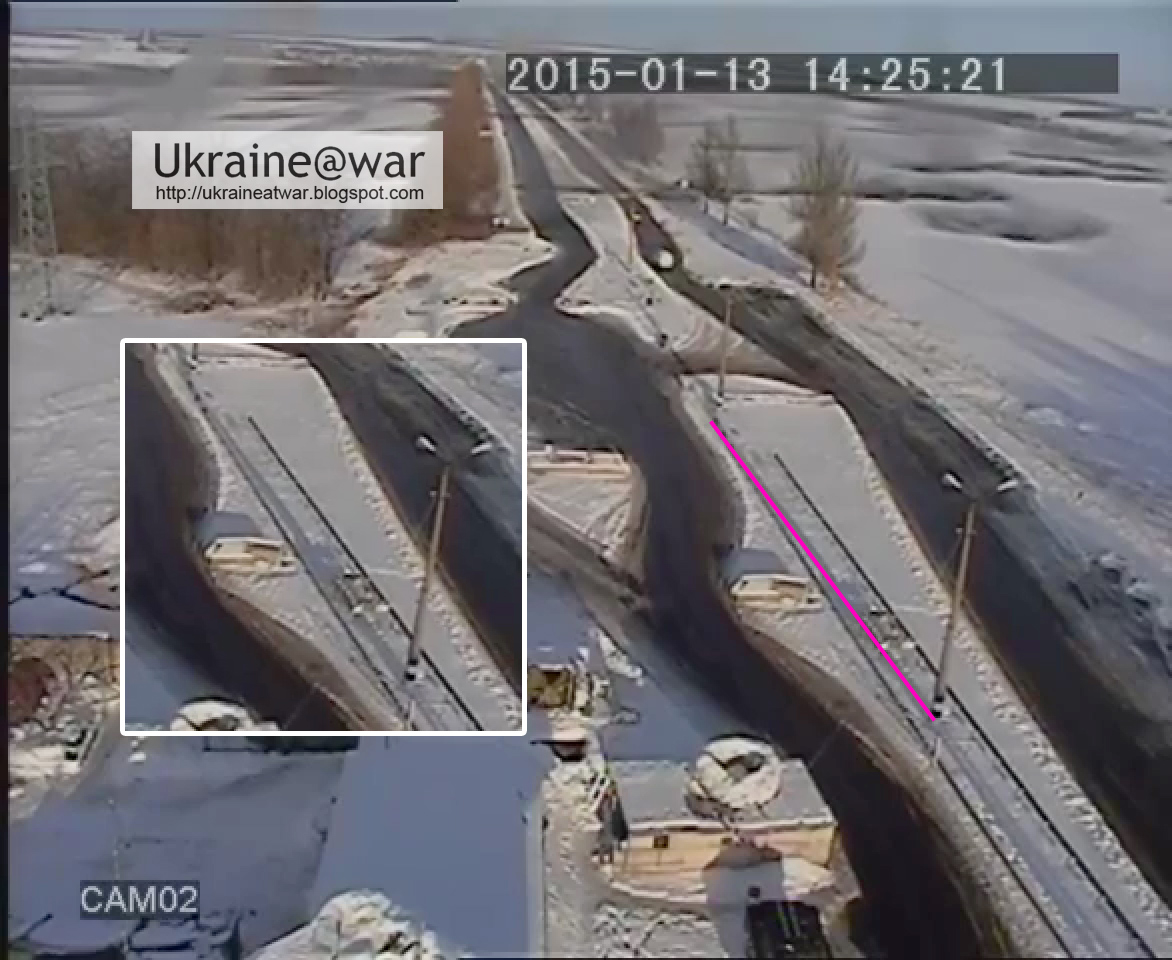
Now we will go to the CCTV video that filmed the bombardment:


The purple line is the shadow of the light pole. I copied that part, so you can see the shadow is indeed there.

Next thing we do, is go to http://suncalc.net (as Gnomon suggested) and look for this location:


You will find a cool overlay drawn over the map. That indicates at what time it will be dusk (dark orange line) and dawn (yellow line). When you change the date this will adjust accordingly. For us right now it is not even that important, but I did set the date on January 13th anyways.

What you do is this: put the marker on the top point of the shadow/purple line. And then move the time-slider (red circle) until the orange line goes right through the light pole. Since MY local time does not correspond with the local time in Volnavakha, it does not give me the right time, but we don't need it. The right DIRECTION is enough, because... and this is the clue... it needs to be EXACTLY the same as the direction/time at the cameramans position!!!
If not, than it was for sure another volley. If it matches it is ANOTHER indication it was indeed THAT volley.

Now that we have the direction/time, we scroll the map to the cameramans location, without changing anything in the overlay:


When we compare our previous findings with this one:


we see that the directions, and THUS the time EXACTLY matches! Wow...


Conclusion
This volley was fired at the same time as the attack that happened on the checkpoint...

It means we have these indications now:
  1. it was at the same time
  2. the length of firing was the same as the length of impacts
  3. the approximate direction was towards Volnovakha
  4. the launch location corresponds with the (approximate) impact direction
  5. other locals confirmed in VK-chat that from this neighborhood had been fired
  6. another local indicated that that area is a known firing position.
What more do you want?
Well satellite images actually, but we will wait for Google to update them.


Also see; possible launch location detected for Volnovakha attack.
Also see: bus with civilians hit near checkpost Volnovakha.

Monday, January 19, 2015

EVERYTHING you EVER wanted to know about Russian Generals in Ukraine

A Tale of Two Russian Generals
The small Ukrainian Armed Forces checkpoint at Buhas on the H20 highway 2 km north of Volnovakha is now infamous due to a GRAD rocket strike there on 13 January 2015. (Another infamous attack happened near Volnovakha on 22 May 2014.) Ten civilian bus passengers were killed instantly, another two died later in hospital, and another 17 passengers were injured according to the OSCE Special Monitoring Mission to Ukraine (SMM) [source].
However, the subsequent visit to the site of the Volnovakha bus massacre by a SENIOR RUSSIAN OFFICER tells its own tale.

A site inspection was organised by SMM on January 16th. This involved a ‘joint investigation’ by representatives of the Joint Centre for Control and Co-ordination (JCCC): a Ukrainian Major-General, his Russian counterpart, and members of the so-called ‘Donetsk People’s Republic’ (DPR).


It is the presence of Major-General Alexander (or Aleksandr) Yuryevich Vyaznikov that concerns us.

What is the Commander of Russian Federation forces in the occupied Donbas region of South-East Ukraine doing 65km from the Russian border, inside Ukraine? The Buhas checkpoint lies 7 or 8 km from Novotroitske: the nominal contact line between Ukrainian defenders and the Russian invaders and their DPR militia, southwest of Donetsk city. This may not sound far. But in terms of ‘military diplomacy’ the presence of Vyaznikov on Ukrainian soil at all, let alone across the contact line, is alarming.

The JCCC headquarters (HQ) is in Debaltseve, 55 km northeast of Donetsk city. The Ukrainian and Russian military staffs are each led by a senior officer, selected by their respective General Staffs in Kyiv and Moscow. These two Chiefs of Staff or ‘representatives’ at JCCC HQ are military negotiators with considerable power to make decisions concerning the so-called ‘ceasefire’ and the ‘buffer zone’ that extends 15 km each side of the agreed contact line between opposing forces. They are in effect the senior military commanders on the ground.
We now focus on the Russian representative.

When the JCCC became operational on 26 September 2014*, the first Russian representative was Lieutenant-General (2 star) Aleksandr Ivanovich Lentsov. We mention him because, as you will see, there is a pattern.


First Russian representative at JCCC: Lentsov

Briefly, Lentsov is a veteran of the Soviet war in Afghanistan and the Chechen Wars [source and source]. In the First Chechen War, he earned a reputation as a hardcore Colonel commander of tactical groups of Russian Airborne Troops (VDV). Subsequently promoted to Major-General (one star), Lentsov then commanded a Russian peacekeeping brigade of 1,500 paratroopers (drawn from 76th and 98th airborne divisions) in Bosnia in 1996 [source and source]. Lentsov was given command of the 98th Airborne Division (Ivanovo).


By 2006 Lentsov was a Deputy Commander of VDV. In 2011, VDV Commander Lieutenant-General Vladimir Shamanov gave Lentsov the task of developing VDV ‘interoperability’: joint planning and operations with Ground Troops and Naval Infantry (marines) brigades [source]. Lentsov was subsequently promoted to Deputy Commander of the Ground Forces of the Russian Federation and raised to Lieutenant-General (2 stars).

Everything that happened in Donbas since 26 September 2014 that involved Russian Forces happened ON LENTSOV'S WATCH.
As Russia’s JCCC representative, Lentsov lead negotiations with Ukraine’s JCCC representative (first Lieutenant-General Yuryi Dumanskyi, later Lieutenant-General Voldymyr Askarov) about all military matters, including the conflict point at Donetsk Airport. monitored by SMM.

For example, in Donetsk on 22 November they discussed options for de-escalation of the situation at Donetsk airport and the use of UAVs [source]. At other times Lentsov met with members of either DPR or LPR without the Ukrainian representative (e.g. in Luhansk on 3 December [source].

(At the end of November 2014 we received rumint that Lieutenant-General Lentsov was saying the so-called ‘Army of Novorossiya’ is a piss-poor militia that should be replaced by Russian Ground Forces contractors.)

But as we know, while these meetings involving one of Russia’s most senior military officers were taking place, Russian military equipment, troops and supplies destined for pro-Russian militias CONTINUED TO FLOOD across the border into Donbas throughout October to December. It is absurd to think that Lentsov (and Russian General Staff back in Moscow) was ignorant of these efforts to support and strengthen the Russian military occupation.

On 8 December at JCCC HQ, Askarov, Lentsov, Denis Pushilin (DPR) and Aleksandr Shubin (LPR) signed orders to implement a general ceasefire to start 09:00 hrs on 9 December [source]. On the day of the ‘ceasefire’ the same signatories were instructing their JCCC officers to follow up on numerous reports of ceasefire violations! [source].


From 16 December, as part of the rotation of officers in the JCCC, the head of the Ukrainian side, Askarov, was replaced by Major-General Aleksandr Razmaznin, Deputy Head of the Joint Operations Centre of the Armed Forces of Ukraine; and the head of the Russian Representation to south-eastern Ukraine, Lentsov, was replaced by Major-General Alexander Vyaznikov, Deputy Commander of VDV peacekeeping operations and the Collective Security Treaty Organisation’s (CSTO) Collective Rapid Reaction Force (CRRF) [source]. At this juncture, Lentsov was rotated back to Moscow and promoted on 13 December to Colonel-General (3 stars)**.


SECOND Russian representative at JCCC: Vyaznikov

At first, it would appear that Lentsov was replaced by a lesser-rank officer (a Major-General). At the time, some commentators said it indicated that Russia’s Minister of Defence, General Sergei Shoigu, and General Staff were downplaying Russia’s representation in the JCCC. The alternative view (and hindsight) is that Moscow decided on a change of emphasis: less negotiation and more operational cover for covert Russian military activities in Donbas.


In reality, Vyaznikov is a specialist: ideally suited (more so than Lentsov) for Russia’s operations in Donbas – and potentially beyond. Who is this Vyaznikov, and why is he so important?


Vyaznikov first came to our attention in August 2014 at a time when it looked as if Russian General Staff were preparing to send a large contingent of Peacekeeping Forces (MC) to ‘keep and enforce the peace’, in other words occupy, Donbas.
On 24 May, Vyaznikov told Anna News that Russian peacekeeping troops were ready to enter the territory of Ukraine. “If we receive an appropriate order, we are ready to carry it out”, said Vyaznikov [source]. On 22 August 2014, TASS reported that Russian VDV had completed the formation of a 5,000-strong peacekeeping force under Vyaznikov [source].


Vyaznikov at Donetsk Airport Jan 6th 2015 [source]


Vyaznikov is a veteran of the First and Second Chechen Wars. He gained a reputation as an effective ‘assault and occupy’ combat leader. In 2008, Colonel Vyaznikov was Commander of the Tula Division or 106th Guards Airborne Division [source] before moving to command the 7th Guards Air Assault (Mountain) Division. Around 2009-2010 Vyaznikov was instrumental in reforming the VDV [source]. He gained a reputation as a moderniser with a strong focus on maximum combat training [source], which lead to promotion (2011?) to Major-General and appointment in 2013 as a Deputy Commander of both VDV Peacekeeping Operations and the Russian-led the CSTO CRRF [source]. In November 2014, Vyaznikov led ‘Srem 2014’, a joint exercise between Russian airborne troops and Serbian special forces [source]. From this advanced combat exercise involving cooperation and coordination between Russian VDV and ‘allied’ forces (for that substitute DPR/LPR militias), Vyaznikov moved to JCCC HQ in December.


On their first day at JCCC HQ, Vyaznikov and Ukrainian representative Major-General Razmaznin said their focus would be on fact-finding regarding ceasefire violations [source]. Since then, the working relationship between Ukrainian and Russian representatives at JCCC has been ‘matter of fact’. Vyaznikov has a reputation for professionalism but difficult. For example:

According to SMM, on 19 December Razmaznin announced that all JCCC members would be fully ready to launch joint patrols across all DPR and LPR-controlled territories by 28 December [source]. However, on 25 December – three days after speaking at LPR press conference in Luhansk [source and source] – Vyaznikov announced that the Russians would not take part in joint patrols. Instead, Vyaznikov suggested the Ukrainians should carry out joint patrols with DPR and LPR militias [source].

But recent events on the ground in Donbas and at Donetsk Airport speak volumes about what Major-General Vyaznikov has really been doing since his arrival at Debaltseve.

On 22 December we stated that Vyaznikov is not in South-East Ukraine to negotiate; he is there to plan assault operations and the occupation of Donbas. On what basis? Although The Russian Ministry of Defence maintains that Vyaznikov is a ‘peacekeeper’ who is in JCCC to ‘negotiate’, Vyaznikov’s entire professional career is that of a hardcore airborne assault leader. The fact that he is entrusted with responsibility for the CSTO’s Collective Rapid Reaction Force speaks loudly. Vyaznikov is a specialist in airborne forces combat tactics and logistics, peace-enforcement operations (i.e. violent suppression of forces) and interoperability operations (i.e. between VDV and special forces and/or marines and/or militias). A dangerous skill set, for an alleged negotiator.

On 22 December we stated “There’s only one reason Russian MoD puts someone like that as head of Russian Occupation Forces”. Vyaznikov is a ‘seize and hold’ tactician. He’s the kind of hardcase commander needed for the job of taking territory, holding it, organising supporting fire and logistical support, and extending Russian military authority over local militias. All of these things have happened in Donbas on Vyaznikov’s watch. From the consolidation of Russian Forces’ occupation, elimination of troublesome (uncontrollable) militia commanders, advancing across the agreed contact line to seize more Ukrainian territory south of Donetsk, to the recent and ongoing assaults to occupy Donetsk Airport. Vyaznikov is definitely on the ground in Russian-occupied Donbas to prepare for (more) war. Vyaznikov is anything but a forces’ withdrawal specialist (Yes, there are such things!) and peace negotiator.


Conclusion
Major-General Alexander Vyaznikov, Deputy Commander VDV and CSTO Rapid Reaction Force, is the senior Commander of Russian Federation forces in the occupied Donbas. He has authority over all Russian units in South-East Ukraine, including the pro-Russian DPR and LPR militias. No GRAD MLRS or D-30 howitzer is loaded and fired at Ukrainian positions without his knowing it or his say-so. If Vyaznikov wanted Russian artillery to stop firing on Donetsk Airport, it would stop. That’s why we became very angry when we saw a photo of him standing with Russian troops ‘inspecting’ – under OSCE monitors’ noses – Ukrainian supply trucks on their way to resupply the Cyborg defenders at Donetsk Airport. But even angrier when we see Vyaznikov ‘inspecting’ the site of the Volnovakha bus massacre on 16 January.
HE HIMSELF... has responsibility for the GRAD rockets fired from Russian-occupied territory that killed those innocent civilians.


When all is said and done, Vyaznikov may be rotated out of JCCC and replaced with another Major-General. One thing is certain: there are plenty more Russian VDV commanders with long experience in assault and occupy operations. Mariupol is the next one to watch.


By GorseFires Collectif

19 January 2015


* The JCCC was established on 20 September 2014 in Debaltseve by Ukraine’s Ministry of Defence in cooperation with Russia’s Ministry of Defence. It is monitored by OSCE. The JCCC works on ‘issues related to the ceasefire regime and the stabilization of the situation, with the participation of representatives of Ukraine, the Russian Federation and the OSCE’ [source].
The aim of the JCCC is (or rather was) to ‘promote a further de-escalation of the situation in the region of Donbas and ensure the effective control and verification by the OSCE of the existing agreements on compliance with the cease-fire regime, the withdrawal of illegal armed formations and their equipment from the territory of Ukraine, as well as the establishment of an effective control over the Ukrainian-Russian border’ [source].
This being part of the Minsk Protocol of 5 September and Minsk Memorandum of 19 September 2014.

** On 18 December 2014, newly promoted Colonel-General Lentsov was approved by Putin as a candidate to command either a Russian Military District or unified strategic command in future.


Sunday, January 18, 2015

Russian media claims Ukrainian SBU posted Volnovakha analysis on this blog

Lifenews (better know as Lienews) reports that the hackers Cyber-Berkut were able to steal documents that proof that Ukraine planned a provocation at Volnovakha checkpoint and that the SBU wote the analysis on my blog...

This is the original tweet from lieNews:

Here is the link to their article. This is a link to a cached article.

These are the 'documents' used:

That last document mentions the blog including the exact link to my blog, for which I say: many, many thanks!!

Some comments:


My response:

WHAT A NONSENSE!
They KNOW I started working for the CIA after I was kicked out of the Mossad!!
And they also know I GIVE ORDERS TO THE SBU and their US puppet government, NOT the other way around!
Proof? I posted the analysis FIRST and THEN I told them to translate it and post it on one of their own sites!

SO I AM OFFICIALLY OFFENDED NOW AND I DEMAND A PUBLIC RETRACTION!

Pfff, ME taking orders from the SBU...
Who do they think I am?


Original analysis.
Possible launch location for the GRAD MLRS.

You can find the Volnovakha blog in Ukrainian here.
You can find the posible launch location in Ukrainian here.

Saturday, January 17, 2015

Possible launch location determined for Volnovakha attack

A combination of things point towards a specific launch location. First of all the direction of impacts as determined earlier. But there is more:
  1. the impact angle says something about the range
  2. VK-chats mention an area
  3. local informant specifies areas
  4. a (distant) video of the launch may have been recorded
Let's discuss all...


Impact angle up to 60º
There is a good clue that indicates the GRAD rockets hitting Volnovakha checkpoint were fired at long range: the impact angle seems to be 60º

Peter Johnson made this graph:


showing that the perpendicular angle on the middle line of the blast pattern on the bus is some 60º.

This is the comment he gave:
The point where the green middle line in his graph hits the ground is also ALMOST perpendicular at the impact point (red line):


This means the REAL impact angle of the rocket might be slightly less then 60º. 

Because this is only a very ROUGH estimate, we should say that the launch location is somewhere between 15 and 20 kms distance (if rockets with max distance of 20 kms were used).

Again, as stated in the previous analysis, these lines are an indication from which direction the rockets were fired (red arrow):


VK-chats indicates neighborhood
Catherine Fitzpatrick picked up on some chats in VK were locals were talking about what was going on. She translated some essential parts of this here:
That mentioned neighborhood Staraya Koloniya is here on the map:


As can be seen it is within range and determined direction (red area). And it is at 17 kms distance.


A local informant specifies known areas
A local witness (with twitter-handle @whicard5) gave me several locations they know are used to launch GRAD attacks unto Ukrainian positions during the previous days. I mapped all of them out here:


Yellow pin = firing position
Red line = direction of fire at Ukrainian villages/nearby positions

Although it is very hard to independently verify such information, my impression is that all these locations COULD potentially be good firing positions and a couple of locations match with what we already knew from other sources (geolocated videos and such).

Interesting is that a location WITHIN Staraya Koloniya is given as a KNOWN firing position!

This local had talked to several people and concluded that the most likely firing point was the one West of Yasne. But he also agreed that more than one location could have been used.

According to me, West of Yasne is the most unlikely place of all mentioned as a GRAD firing position, because it is VERY close to the front line with high risk of detection and counter attack. Nevertheless: you never know what happens during a war and it could still be true.


Somebody in Dokuchajevsk filmed outgoing artillery on January 13th
Another person pointed me towards a Youtube channel with 4 videos from somebody who had filmed the sound of outgoing artillery in Dokuchajevsk from his apartment. Three of them are from January 13th...

The second one has a time of 15:50 mentioned in the title, which is too late because the attack happened at 14:25.

Assuming that the 3rd was was later and the 1st one was earlier, it means the first one MIGHT even have recorded the Volnovakha salvo...


It is a rather lengthy video of 11 minutes and it is boring to watch, but starting at 2:55 something very interesting can be heard what definitely sounds like a massive distant launching of GRAD rockets. The sound continues until 3:08 (13 seconds), but there is still noise after this of flying rockets.

Now the Volnovakha IMPACTS start at 14:24:57 and end at 14:25:10, with one single more impact visible at 25:13. So that is 13 seconds long!

What's also interesting is that the cameraman seems to be filming into the direction where the sound is coming from and after that into the direction where he thinks the rockets are flying.
It is very well possible that he actually sees them flying, but the camera cannot record it because the sky is too overexposed and the resolution/quality too low.
Even more: he is ALREADY filming into the launch direction at 2:52 and ALREADY zooming in a second BEFORE the sounds is audible! It means HE SAW it already and the sound comes later...!


Traces of smoke visible
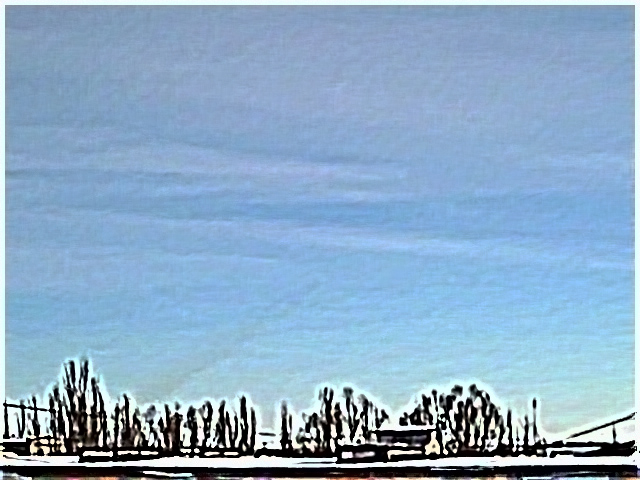
User 'Gnomon' posted info to the blog to show that he has been able to recover traces of smoke from the video. He writes: "Image 1 is a single frame from the video (2.55). Image 2 is processing in a special way to enhance local contrast. The smoke from the rockets can be seen within a few seconds (more than 5 seconds) in this video."


He has also been able to detect some GRAD rockets flying:


Direction of view
This is a screenshot from the video:


The yellow frame is where he zooms in.

This is how the cameraman is filming at that particular moment:


Blue line = wide shot
Yellow lines = zoomed in shot
Orange line = center of zoomed in shot

Google maps link.

Zoomed out it looks like this:


The center of his view (dark orange line) is directed TOWARDS Staraya Koloniya (orange area)and ALMOST right through the designated area that is a KNOWN firing position (yellow pin)...

When the cameraman is looking in to the direction where the rockets go, this is his view:

In Google Earth it looks like this (bus location in the middle at horizon):


He is DEFINITELY looking into the direction of Volnovakha, but the center of his view is not EXACTLY towards the checkpoint. This makes sense of course. He is looking into the sun AND his view is blocked by a hill/slagheap. He is searching for where the rockets go and filming into an approximate direction.

So what we have is this:
  1.  a video uploaded on January 13th
  2. likely BEFORE 15:50
  3. it is recording lots of outgoing artillery and definitely recorded an outgoing GRAD salvo.
  4. he must have seen the (smoke of the) rockets flying, but the low quality camera could not record it
  5. he was filming towards the launch location which is a KNOWN firing position
  6. this location corresponds with the area discussed in the VK-chat
  7. he is also filming into the direction where the rockets go. This is Volnovakha.
  8. The length of the firing of the GRAD salvo corresponds with the time-frame of impacts in the CCTV video.
Conclusion: it is VERY LIKELY he was filming the actual salvo that hit the bus at Volnovakha checkpoint.


Launch location
Even though my local informant tends to opt for another location, everything else seems to indicate that the Staraya Koloniya area was used red circle:


It might even have been the position they have used before:


Video compilage
Now we have THREE videos of the attack. The likely launch, the CCTV of the impacts and the dashcam that shows when the bus was hit.

Here you can see all three playing simultaneously in one video:


Wednesday, January 14, 2015

Bus with civilians hit at Ukrainian checkpost near Volnovakha

Originally my analysis of the Volnovakha incident can be found here:
 Here is a situation map:


On a larger scale that looks like this:


Clearly the rockets came from Russian occupied territory.

In addition I tweeted these things about it, because they argued it was cased by a Ukrainian MINE:


The impacts in the bus show a banded pattern:


This can even be extended to the tree. Such a banded pattern is typically for MLRS impacts, such as GRADs.

Here is such a pattern from GRAD on an apartment building in Pervomaisk:


The red X is the impact crater.

This is how a warhead of a GRAD explodes:


It is in a circle around the rocket. It explodes TO ALL SIDES.
When we put the images together, you get this:


To be precise, the upper side of the warhead matches with the upper blue line:


While the bottom of the head matches with the lower blue line:


All in one picture:


So a typical GRAD blast pattern is:
  1. banded
  2. at an angle 
  3. widening further away from the epicentre
This is EXACTLY what we see on the bus:


What's interesting about this, is that we can draw a plane from the banded pattern through the impact hole. And then the impact direction is perpendicular to this plane!


(sorry for not being able to draw a better image.)

Also this perpendicular angle has to EXACTLY match the impact hole in the ground (dotted yellow line):


So, in this Volnovakha case we see that:
  1. the impact pattern is banded
  2. it is at an angle
  3. it is widening further away from epicentre
  4. the perpendicular direction matches the direction of the impact crater
A mine would give a TOTALLY different pattern.

Conclusion
The Russians attacked a Ukrainian checkpost where a bus with civilians was waiting to pass by.
A MLRS rocket (GRAD or larger) hit in the field nearby.
The blast exactly covered the side of the bus, creating the multiple casualties that we see.


UPDATE 14-1
This video is showing the MLRS attack on the Volnovakha checkpoint:


This is a screenshot:


At least 33 explosions can be counted.
The video has been recorded like this:

It means the bus and the hit on the bus can not be seen.
Yet the shadow of that impact CAN be seen on the video (large red circle in screenshot above).

So this video confirms the findings I already explained above. But it also debunk all troll theories.

Here I have mapped all impacts as best as I could:


There are even some 50 impacts!
It means more than one GRAD launcher must have been used. (If it was not heavier than GRAD).

But also we see the impacts are cut off on top. That is because the camera did not film them.


My prediction: there have been (a lot) more impacts!

MLRS in general show an oval pattern. The question is how big that oval was:


Or like this:


The direction of an MLRS attack is related to this oval pattern like this:


But we need to have a COMPLETE picture first before we can tell something about the final pattern and related direction.

My prediction: since more than 50 impacts can be counted more than one MLRS launcher has been used. And since not all area has been filmed we will find that a lot more impacts have occurred. We have seen dozens of movies with up to five GRAD-launchers, which means 5x40=200 rockets may have been fired...

Let's see what OSCE comes up with...

UPDATE
This is what OSCE came up with:


For more details about GRAD dispersion, look here:
And then Peter Johnson asked an important question, I had not considered yet:


Since the distance/diameter of the area covered is 630 meters, it would mean with the given formula the rockets were fired from some 80 kms distance. Impossible!
Thus the simple conclusion is: this has been caused by MORE THAN ONE MLRS launcher. We already knew this because we had some 50 impacts. So this is a confirmation that multiple launchers were involved.

Bad news is that therefor the spread pattern will not help us to confirm the direction. But that is not a big problem, because we already now the direction.

Another indication that multiple launchers were used, is that the first 6 explosions happen within 0,28 seconds:


So, just to make sure everybody understands... MULTIPLE launchers must have been used, because:
  1. there are some 50 impacts and GRAD has 40 tubes
  2. spread pattern is WAY too wide for one launcher
  3. 6 first, almost simultaneous impacts can't have been caused by a single launcher.

UPDATE II
A full length speed-up video has been released:


The camera turns to the back now, so we can count some more impacts, but not sure about some:


The total image looks like this:


Conclusion: the pattern says nothing about the direction :P.

The video DOES show something else though: civilian cars pass the checkpoint CONSTANTLY. It was not an unfortunate accident that civilians were hit. It was fortunate that NOT MORE civilians were hit! And it was IMPOSSIBLE NOT to hit civilians:


Draw your own conclusions on that...


These are remains of the rockets found:


For comparison see this GRAD rocket from a different place:


Conclusion: these were GRAD rockets, probably three launchers and they did not fire all their rockets.


Also this photo shows that we don't have to have ANY doubt about the direction:


It is as was determined from the beginning:


UPDATE 15-1
A dashcam video appeared:


The impacts can be found starting at 1:11.

What's clear from this video is that AN ENTIRE ROW OF CARS was waiting to get through the checkpoint, including one more bus:


Some 15 cars including another bus had been waiting there.
Out of some 60 impacts ONLY ONE HAD HIT.
SO MANY MORE victims could have been there if the volley was on target!!!

Zoom in on moment of explosion:


People are walking at the side of the road just before impact 1:12:


With this dashcam video the deliberate attack on broad daylight on Volnovakha Checkpoint with a row of civilians cars waiting to get through, is the BEST DOCUMENTED Russian attack on civilians so far.

So to all Ukrainians... get your cameras out, grab your phones, instal these dashcams... because THAT is how we can prove and show the world what these Russian xxx are doing.


UPDATE 15-1
Retweet this tweet, to fight the Russian trolls who still desperately clinch on the a-mine-exploded-theory because that is all they have:
You can see for yourself in this zoomed in, stabilized and slowed down video:


UPDATE 16-1
The Russian St-Petersburg Trolls just can not stop... Latest trend is to say that an ENTIRE minefield blew up:


Maybe because Tripwire Graham walk there?

I will NOT give the link to the video, because I do not want to promote such nonsense.
The reason why you don't see clear explosions of fire is because most of the rockets get buried (deep) into the snow and ground before exploding. Although SOME fire can be seen.

Furthermore: scroll up to see the debris of the GRAD rockets sticking into the ground... taken from the aftermath video.

UPDATE 16-1
Some trolls say a soldier was spotted in a video wearing a claymore mine. This is the message for those who can not afford to by spectacles due to underpayment:


Watch zoomed in, stabilised and slowed video here:


Also see: possible launch location determined for Volnovakha GRAD attack.

Do you appreciate this and other articles? Do you think it is important that this information is published?
I'm not working for a newspaper or magazine. If you sponsor me, you help me to keep this blog up and running.
See the Paypal Donate-button in the top right side of this blog or subscribe in the About-me-section.